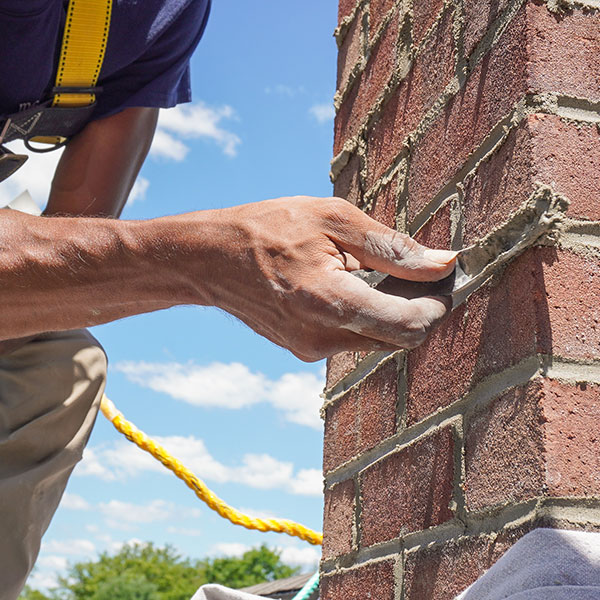
Replacing mortar on schedule is routine maintenance. Waiting until the brick fails turns it into a rebuild.
It depends on your wall. Tell us where you are and local masons will price your actual project, free.
We're not a masonry contractor. We pass your request to the ones who are.
Replacing mortar on schedule is routine maintenance. Waiting until the brick fails turns it into a rebuild.
Contractors price by the square foot of mortar joint. Where you land in the range comes down to access, how much of the wall has failed, and whether the mortar has to be color-matched.
These are national figures, roughly $5 to $25 per square foot. What you're quoted depends on where you live and how much of the wall has failed.
Mortar is softer than brick on purpose. It wears out first so the brick doesn't have to. Leave it too long and the damage moves to the brick, which costs far more to fix.
Water works into an open joint, freezes, and expands. In Chicago that happens about 68 times a year, and every cycle pries the joint a little wider.
Once joints open up, water crosses the wall. Damp patches or white chalky residue on an interior wall mean it's already happening.
Left long enough, brick faces flake off and corners crumble. Repointing won't fix that. Sections have to be rebuilt, which costs several times more.
No cost, no obligation, and no surprises about who calls you.
That's all we need to start. Details and photos help a contractor prepare, but they're optional.
Your request goes to masonry contractors working in your area.
Usually within 24 hours, by phone, text, or email, so you can compare instead of taking the first number you hear.
Only phone and ZIP are required. The rest helps the contractor show up prepared.
Tuckpointing is usually priced per square foot or per linear foot of mortar joint, and contractors commonly cite ranges around $5 to $25 per square foot depending on your region, the extent of mortar damage, and whether the brick is a standard or historic profile. Small chimney or foundation repairs may run a flat few-hundred-dollar minimum, while full facade repointing on a larger home costs more.
Repointing means removing deteriorated mortar and replacing it with new mortar. Tuckpointing is a specific repointing technique that uses two mortar colors — one matching the brick and a thin contrasting "tuck" line — to create the illusion of fine, uniform joints, historically used to make common brick look like more expensive rubbed brick. In everyday use, especially in the Midwest, "tuckpointing" is often used loosely to mean any mortar joint repair.
Common warning signs include mortar that is crumbling, powdery, or missing between bricks; visible cracks in the joints; water stains or damp spots on interior walls near masonry; and bricks that feel loose. Homes built before 1960 are more likely to need it, since older lime-based mortars wear faster than modern Portland cement mixes. Freeze-thaw cycles accelerate the damage, so homes in colder climates tend to need repointing more often.
Usually not. Most homeowners policies treat deteriorating mortar as gradual wear and maintenance, which is excluded. Coverage is more likely if the damage was caused by a sudden, covered event, such as a storm or a burst pipe. Check your specific policy or ask your insurer before assuming either way.
You submit your phone number and ZIP code (plus any project details you'd like to add). We pass that request to local masonry contractors, and up to three may contact you directly by phone, text, or email to discuss your project and provide a quote. There's no cost or obligation to use the service.